
Where would you place your firm right now?
Richard Brewin • December 11, 2020
Clients relationships matter.
They always have but now more than ever they are the measure by which clients engage, stay or go elsewhere.
Why now more than ever? I think that there are three critical influences:
- Clients are under pressure and so the level of support is being both tested and judged
- Competition is greater than it has ever been. Clients can now go to multiple sources for their accounting, tax and advisory needs
- Client expectations have changed, commercially and socially. They expect different and they expect more
How your firm responds to these circumstances and manages its clients expectations and needs will go a long way to determining your own success.
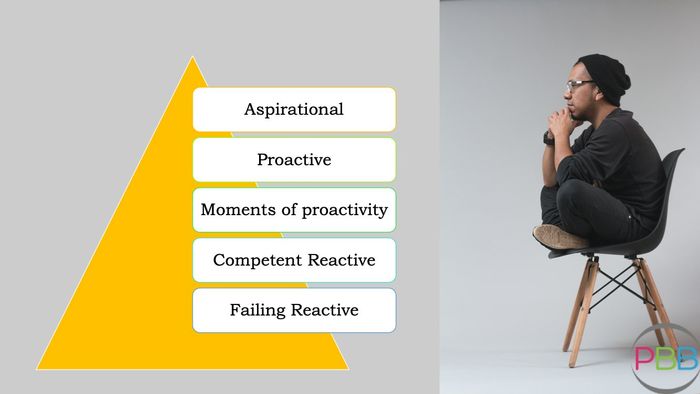
To this end, we have created the 5 levels of client management and service. Let’s go in reverse levels of glory:
- Bottom of the pile is ‘Failing Reactive’. Firms in this category are entirely reactive and slow to respond to go with it. They only do the work and respond to the demands that clients put in front of them and they are slow to turnaround both. Consequently there is little to no advisory or support and compliance takes for ever. There are far too many accounting firms in this category but their numbers dwindle as they themselves disappear.
- One step up and we have ‘Competent Reactive’. Firms in this category are, again, entirely reactive but at least they get on with it. The relationship is still driven by client delivery and request but service is recognised and turnarounds are reasonable. If we’re being honest then many accounting firms live here, albeit with frustrated principals.
- Next up is ‘Moments of Proactivity’. Firms in this category remain fundamentally reactive but occasionally have bursts of more proactive service. The problem is that it is neither cultural nor systemised and so it is rarely maintained. Bad habits drag behaviour backwards. These are firms who brand as proactive but know in their heart of hearts that it is by wish rather than record. This is probably the other most populated group with Step 2.
- Step 4 sees us close to the peak, truly ‘Proactive’ firms. Firms here have systemised their processes and behaviours to ensure that they consistently remain ahead of the game and are proactive at all times. They have proactivity embedded in their people and their culture. To be honest, Step 4 is the peak for most of us and an amazing one to reach. For most, it is certainly good enough, an aspiration in its own right.
- But, their remains a Step 5, only for the select few. Step 5 is for the ‘Aspirational’ firms, those that aspire to go beyond even complete proactivity. Firms who want to be cutting edge today and every tomorrow. Firms who want to be the absolute, undisputed best. It is a goal for some.
So I have two questions:
- Hand on heart, where would you place your firm right now?
- Having determined that, do you need and are you prepared to go to the next step?
If so, now would be a really good time to do something different to get yourself there!

In the Accountant/client relationship, “yes” often feels like the default. Yes to urgent requests. Yes to timeline shifts. Yes to “just one more thing” added to the scope. We want to say yes to our clients. We want to support them, be helpful and build more work, but every unqualified additional yes becomes an invisible cost; on your time, your margins, and your wellbeing. Bold accountants think differently. They know that “no” isn’t rejection. It’s honest and professional. It’s a strategic decision that protects quality, strengthens relationships, and reinforces your value.

Let’s be honest, most business owners have a perception of an accountant that probably falls far short of our ambitions. They want someone who helps them make sense of the chaos, plan for growth, and sleep better at night knowing someone’s got their back, but their accountant doesn’t usually spring to mind as this person. What they dream of is a coach, not an accountant, but, weirdly, they often don’t trust coaches but do trust their accountant. Their accountant can be both, so the client gets the trust and the coaching

Artificial Intelligence isn’t the future of accounting — it’s here now. From automating repetitive tasks to delivering deeper insights, AI is transforming the way we work, serve clients, and lead teams. But for firm leaders, success isn’t just about implementing technology; it’s about doing it strategically, responsibly, and humanely . Before diving into the ‘how’ and making piecemeal decisions, accounting firm leaders need to consider the ‘why’…and its not as simple as “because everyone else is”.